
Can You Get Dental Implants If You Have Bone Loss?
Being told you have bone loss in your jaw can feel like the end of the road for dental implants. It isn’t always. Bone loss is common in patients who have had missing teeth for some time, and there are well-established ways to assess, manage and — in many cases — work around it.
Whether implants are right for you depends on how much bone remains, where the loss has occurred, and your overall health. This page explains what bone loss means for implant treatment and how we assess it at Sandgate Bayside Dental. For a full overview of implant treatment at our practice, see our dental implants Brisbane page.
The short answer: Bone loss does not automatically disqualify you from dental implants. Many patients with bone loss are still suitable for implants — sometimes with additional treatment such as bone grafting, and sometimes without. The only way to know is a proper assessment.
Why Does Jawbone Loss Happen?
Jawbone needs stimulation to maintain its density. When a natural tooth is present, the tooth root transmits bite forces into the bone, which signals the bone to keep regenerating. Once a tooth is removed, that stimulation stops and the bone in that area begins to resorb — shrink and lose density over time.
The rate of bone loss after tooth extraction is highest in the first year. After that it continues more gradually, but the longer a tooth has been missing, the more bone is typically lost. Other causes of bone loss include:
- Periodontal (gum) disease — a leading cause of bone loss around existing teeth
- Wearing dentures — dentures exert pressure on the ridge rather than stimulating bone, accelerating resorption over time
- Trauma or injury to the jaw
- Infection or abscess that has destroyed surrounding bone
- Certain medical conditions or medications
This is one of the reasons replacing missing teeth sooner rather than later is recommended — the longer the gap remains, the more bone you lose and the more complex any future implant treatment becomes.
How Is Bone Loss Assessed Before Implant Treatment?
A standard 2D dental x-ray can suggest bone loss is present, but it cannot accurately measure bone volume in three dimensions. For implant planning, a CBCT scan (cone beam computed tomography) is the gold standard. This produces a 3D image of the jaw that allows your dentist to measure bone height, width and density at the exact site where an implant would be placed.
CBCT scanning at Sandgate Bayside Dental
We have an in-house CBCT scanner, which means your 3D imaging is done at the same practice as your implant assessment and treatment — no referrals to external imaging centres, no extra appointments, no additional waiting. This gives us precise data to plan your treatment accurately and have a direct conversation with you about your bone levels and options. Learn more about our CBCT scanning capability.

What Happens If There Isn’t Enough Bone for an Implant?
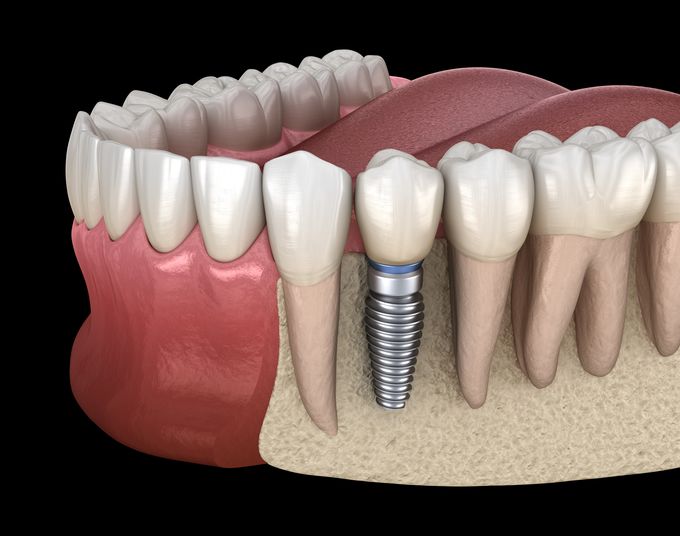
A dental implant post requires a minimum amount of bone — roughly enough width and height to support the implant and allow it to integrate securely. If your CBCT scan shows insufficient bone, there are several approaches depending on the location and degree of loss:
A bone graft adds material to the deficient area to create a suitable site for the implant. After grafting, healing of 3–6 months is typically required before implant placement. It adds time and cost but makes implant treatment possible for many patients who would otherwise be unsuitable.
In the upper back jaw, the sinus cavity can leave insufficient height for an implant. A sinus lift raises the sinus membrane and adds bone graft material underneath. Typically used when replacing upper molar or premolar teeth.
In some cases, remaining bone is sufficient to support a shorter or narrower implant design. Modern implant systems have significantly expanded situations where implants can be placed without grafting.
Patients who have lost most or all of their teeth may be candidates for full-arch implant solutions using strategically angled implants to avoid areas of worst bone loss.
When Might Bone Loss Rule Out Implants?
While bone loss alone rarely makes implants impossible, it can be one of several factors that together make implant treatment inadvisable. Other considerations that affect suitability include:
- Active, uncontrolled periodontal (gum) disease — this must be treated and stabilised before implants are considered
- Uncontrolled diabetes, which significantly impairs healing and osseointegration
- Bisphosphonate medication history — certain medications used to treat osteoporosis can affect bone metabolism and implant healing
- Active smoking — smoking substantially increases the risk of implant failure
- Insufficient remaining bone even after grafting is considered
If any of these apply to you, it’s still worth having a consultation. Many conditions that affect implant suitability can be managed or stabilised before treatment. See our full guide to who may not be suitable for dental implants.
What Do Dental Implants Cost in Brisbane?
At Sandgate Bayside Dental, single dental implants are priced from $4,200 all-inclusive — this covers the implant post, abutment and crown in a single quoted fee. We do not break pricing into separate components that add up unexpectedly.
If bone grafting is required, this is an additional cost that will be discussed and quoted clearly before any treatment begins. Payment plans from $50 per week are available. See our full dental implants page for more detail on the treatment process and pricing.
Concerned about the procedure?
Implant surgery — especially when combined with bone grafting — can feel daunting. We offer IV sedation for dental implant procedures, administered by a dedicated sedationist. Many patients who were anxious about the procedure find it far more manageable with sedation.
Frequently Asked Questions
- Can you get dental implants if you have bone loss?
- How much bone do you need for a dental implant?
- What is a bone graft for dental implants?
- Does having bone loss mean my implant will fail?
- I’ve been told I can’t have implants because of bone loss. Should I get a second opinion?
- Who is not suitable for dental implants?
Often yes. Bone loss doesn’t automatically rule out implants. The amount and location of bone loss determines whether implants can proceed directly, require bone grafting first, or whether an alternative approach such as full-arch implants is more appropriate. A CBCT assessment gives an accurate picture of what’s possible.
Generally, a minimum of around 10mm of bone height and 5–6mm of bone width is needed to place a standard implant. These measurements vary depending on the implant design used. Where bone falls short, bone grafting or alternative implant options may apply. Your dentist will assess this precisely using CBCT imaging.
A bone graft adds bone material to a deficient site to create a suitable foundation for an implant. The material may come from your own jaw, a processed donor source or a synthetic bone substitute. After grafting, a healing period of 3–6 months is typically required before the implant is placed. Bone grafting adds to the total treatment time and cost but makes implants possible in many situations where they wouldn’t otherwise be.
Not necessarily. If bone loss is appropriately treated before or during implant placement, success rates remain high. The key is thorough assessment and treatment planning — which is exactly what CBCT imaging enables. Poorly planned implants placed without proper bone assessment carry a higher failure risk.
A second opinion is always reasonable if you’ve been told implants aren’t possible without a thorough 3D assessment. Some practices assess bone from 2D x-rays only, which can underestimate the bone that’s actually present. A CBCT-based assessment at our practice gives a far more accurate picture and may reveal options that weren’t apparent from a standard x-ray.
Active gum disease, uncontrolled diabetes, recent cardiac events, and certain medications (particularly bisphosphonates) can affect suitability. Many conditions once considered absolute barriers — including bone loss, older age and osteoporosis — can often be managed with modern techniques. Read our full guide on who is not suitable for dental implants.
About Us
For over 30 years, our practice has been caring for people from Sandgate, Shorncliffe, Brighton, Deagon, Bracken Ridge, Bald Hills, Boondall, Taigum, Fitzgibbon, Woody Point, Clontarf, Margate and Redcliffe and other surrounding areas.
Our main priority is to provide affordable, gentle and quality dental care to the Sandgate and surrounding communities.
© SANDGATE BAYSIDE DENTAL 2026 | PRIVACY POLICY